
A Google Business Profile helps shape a potential client’s opinion about your firm before they visit your website.
- Every blank field and missing photo is a small signal to potential clients that your firm may not be worth their time.
- Selecting the wrong categories or leaving services incomplete limits how often and for what searches your profile appears.
- Reviews influence both Google rankings and client trust. The way your firm handles them, positive or negative, is visible to everyone searching.
- Consistent activity across your profile, through posts, updated information, and review responses, strengthens your standing in local search over time.
People searching for a personal injury, workers’ compensation, or disability attorney are facing increased medical bills, minimal or no income, and a lot of uncertainty about how to overcome these issues. Getting legal help quickly matters, and that search often starts on Google.
A law firm Google Business Profile—formerly called Google My Business—is one of the first results searchers see. Typically located just below sponsored ads and an AI Overview, firms with optimized profiles surface with their name, ratings, hours, location, and reviews, all before a potential client visits a website.
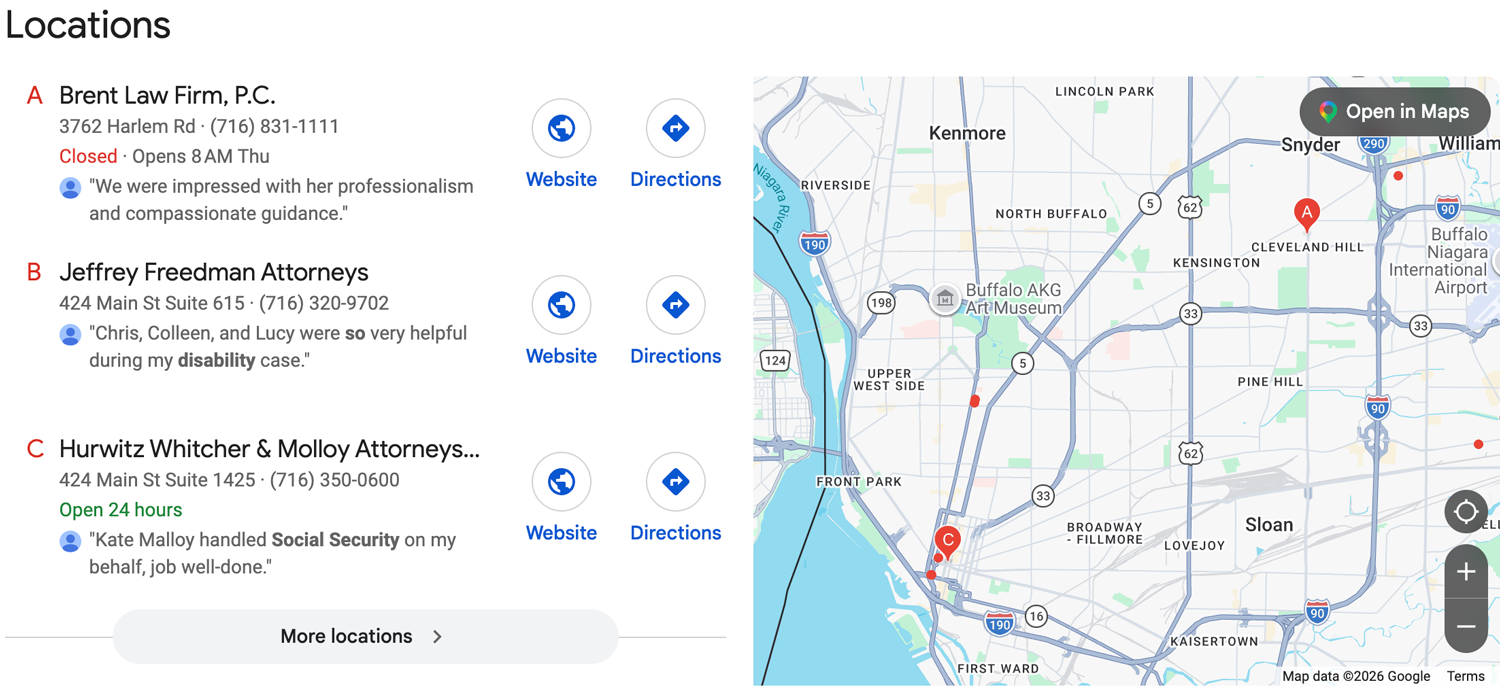
Google determines which profiles to show based on a few factors, including relevance to the search, proximity to the user, and prominence in the local market. The firms showing up at the top have complete, accurate, consistent, and actively maintained profiles. A well-optimized profile can be the difference between capturing interest and being scrolled past (or not showing up at all).
Get the Basic Information Right
Having incomplete or inaccurate business information might seem like an obvious problem to avoid, but it’s a lot more common than you might think. Potential clients who see profiles with missing hours, incorrect phone numbers, or no website link are not going to dig around to find the correct information or figure out how to learn more about that firm. If a firm can’t keep its own listing accurate, searchers may not feel confident reaching out.
At a minimum, your law firm Google Business Profile needs to feature:
- Correct phone or tracking number
- Updated address
- Accurate business hours, including holidays
- Opening date
- Business description
- Website link
- Accessibility information
- Service area for firms that serve a defined geographic region. If your firm operates nationally, don’t select a service area.
- An appointment link that directs users to a relevant form or page.
Manage and Respond to Reviews
Reviews are one of the most influential elements of any Google Business Profile; they shape how potential clients perceive your firm. Naturally, reviewer feedback carries real weight in Google’s algorithm.
Consistent, positive reviews from clients send a strong signal to both Google and searchers urgently looking for legal help. Getting those reviews often involves ethically encouraging clients to share their experience. Personal injury, workers’ compensation, and SSDI cases involve sensitive details about someone’s health, finances, and personal circumstances, so clients are not always inclined to post publicly right away. A low-pressure ask after a case is resolved goes a long way. Just never offer incentives in exchange for a review, as this violates both Google’s policies and Bar rules.
Responding to reviews matters just as much as collecting them. Engaging with feedback signals to Google that your profile is active and attentive, while simultaneously giving potential clients a sense of how you communicate.
If someone leaves you a positive review, be appreciative in your response. Thank them for taking the time to share their experience, and use your response as an opportunity to reinforce your firm’s approach.
In the event you receive a negative review, it’s crucial to respond professionally and empathetically. Avoid discussing any case specifics, and invite the individual to contact the office directly to work through their concerns. An unfortunate reality is that you cannot rely on Google to remove negative reviews, even if they’re inaccurate or unfair. Google rarely removes reviews, which is exactly why your response to them matters so much.
Independent experts bring clarity to marketing and operations.
Explore Better Cases’ consulting services.
Select Relevant Categories
Categories tell Google what your firm does, which directly influences which searches your profile appears in. Choosing a category that is too broad, such as “legal services” or “law firm,” dilutes your visibility for the specific legal needs you actually provide.
Your primary category should be as specific as possible: “personal injury attorney” for those who practice personal injury law or “Social Security attorney” for SSDI lawyers. Workers’ compensation no longer has its own category, so “personal injury attorney” is the best option for lawyers specializing in these cases. Google also allows up to nine secondary categories, but you are not required to fill out all of them. Secondary categories are where general descriptors belong, along with any additional practice areas your firm handles.
Add Your Services
If categories tell Google what type of firm you are, the services section tells Google and potential clients what you specifically handle. For lawyers, these can feel redundant since your practice areas and your services largely overlap. The distinction is that secondary categories are hidden from view and are just for Google, while services are visible to prospects and give details about the work you actually do.
A personal injury attorney, for example, might include slip and fall, wrongful death, and medical malpractice as individual services. An SSDI firm might break out initial applications, appeals, hearings, and SSI claims. For workers’ compensation, this could include workplace injuries, legal representation, and claim disputes.
Add Photos or Videos to Your Profile
Photos give potential clients a sense of your firm. A profile with no photos, or poor quality ones, can quietly undermine the credibility you have built everywhere else. For someone comparing multiple firms in a quick search, visual presentation matters.
Your profile should include:
- Professional headshots of each attorney on your team
- An exterior shot of your building, ideally taken from the curb or sidewalk
- Interior shots of your reception area and office spaces
- A cover photo and logo
A couple of clean, well-lit angles for each is enough. They do not need to be elaborate, but they should look polished. Video is also an option, though photos alone are sufficient for most firms.
Use the Posts Feature
Many attorneys are unaware that Google Business Profiles include a post feature that functions similarly to a social media feed. Posts can cover any range of topics, such as firm news, recent successes, new hires, upcoming seminars or webinars, holiday hours and unexpected closings, or practice areas.
Each post includes a clear call to action of your choosing that can be linked to an action. For example, a “learn more” CTA on a post about a successful case and a link to a piece of content that discusses the case details in full. If you are already producing blog content or posting on social media, repurposing that content for your profile is an easy way to keep up without adding much to your workload.
Get Help With Your Digital Marketing
Optimizing your Google Business Profile for lawyers is just one piece of your digital marketing. Better Cases works with personal injury, workers’ compensation, and SSDI firms to handle the full scope of their digital marketing. The more time your team spends managing marketing, the less time you have available for what actually drives your firm forward: working cases and serving clients. If you want a partner that understands the legal marketing landscape and knows how to generate quality leads, schedule a call with Better Cases.
Get support that fits your firm’s marketing needs.
We’ll help you review what’s working, clarify what you want to improve, and create simple next steps that guide your marketing toward meaningful outcomes.

Chris Reilley – Founder
Chris founded Better Cases after years of helping attorneys adapt their marketing to a changing landscape at his first digital marketing agency, Parkway Digital. His experience showed what worked, what didn’t, and what firms actually needed. His approach prioritizes strategy, efficiency, and results that help law firms.